The Sikorski Memorial: an enduring landmark in Gibraltar
The Sikorski Memorial honours General Władysław Sikorski, a key figure in Poland’s military and political history during World War II. His influence spanned Europe and the Allied forces. Established in 1945, the memorial symbolises solidarity between Poland and Gibraltar, commemorating his mysterious death and the enduring alliance forged during the war.
The Origins of the Sikorski Memorial

The story of the Sikorski Memorial begins in 1945 when the first monument was erected at the eastern end of Gibraltar’s runway, close to the tragic location where General Sikorski’s plane crashed. On July 4, 1943, Sikorski’s B-24 Liberator aircraft crashed into the waters shortly after takeoff from Gibraltar, a fateful incident that claimed the lives of the General and several members of his party. The crash was a deeply traumatic event for the Polish community and marked the loss of a strong leader who had fought tirelessly for Polish independence and for the Allied cause during World War II.
Although initial investigations attributed the crash to mechanical failure, the circumstances surrounding the incident remain unresolved, giving rise to multiple theories, including the possibility of sabotage. For many, the site of the crash became a hallowed ground, and the placement of the original memorial near the runway symbolized a close connection to the last moments of Sikorski’s life. However, as Gibraltar expanded and development progressed around the runway, a need emerged to relocate the monument to a more accessible and prominent location.
The Relocation to Europa Point
In 2013, nearly seventy years after Sikorski’s death, the Sikorski Memorial was moved to a more fitting and accessible site at Europa Point, Gibraltar’s southernmost tip. This relocation was strongly supported by the Polish government, which sought to give the memorial a place of prominence. Europa Point, an iconic location in Gibraltar, offers sweeping views over the Strait of Gibraltar, the Mediterranean Sea, and, on a clear day, the coastline of North Africa. The setting provides a contemplative atmosphere, making it an ideal location for a monument dedicated to a figure of such stature.
The Sikorski Memorial’s re-inauguration on July 4, 2013, brought dignitaries from Poland and Gibraltar, highlighting their strong ties. The updated memorial features a polished black marble slab with inscriptions in Polish and English, honoring Sikorski’s legacy. A bronze bust adds a personal touch, symbolising his resilience and patriotism.
General Władysław Sikorski: A Symbol of Resistance
Born in 1881, General Władysław Sikorski rose to prominence as a military leader and statesman, leaving a profound impact on Poland’s history. His leadership journey began during World War I, and he later played a crucial role in the Soviet-Polish War of 1919–1921, a conflict that helped secure Poland’s independence. However, Sikorski’s most defining contributions came during World War II, following the 1939 invasion of Poland by Nazi forces.
As Prime Minister of the Polish government-in-exile and Commander-in-Chief of the Polish Armed Forces, Sikorski led the fight for Poland’s sovereignty from London. He was not only a military strategist but also a diplomatic force, advocating for international support for the Polish cause. His diplomatic skills enabled him to foster alliances with key Allied powers, strengthening Poland’s position in the struggle against Axis forces. Sikorski was a source of hope and motivation for the Polish people, both in occupied Poland and abroad. His sudden and tragic death in 1943 was a blow not only to the Polish resistance but also to the broader Allied effort, as he had been a unifying figure whose leadership extended beyond Poland.
The Mystery Surrounding the Crash
The circumstances of Sikorski’s death have long been a subject of speculation, adding an element of intrigue and mystery to his legacy. On the evening of July 4, 1943, his aircraft plunged into the sea shortly after takeoff, with only the pilot surviving the crash. Initial investigations suggested that the crash was due to a mechanical malfunction; however, the exact cause of the incident remains uncertain. Over the years, multiple theories have emerged, each adding complexity to the narrative.
One theory ties the incident to tensions between Poland and the Soviet Union, particularly after the Katyn Massacre. Some speculate Soviet operatives were involved, as Sikorski opposed their policies. Others suggest internal conflicts within the Polish government-in-exile or British intelligence intervention. Despite investigations, no conclusive evidence has emerged, keeping his death a mystery.
The Memorials Beyond Europa Point
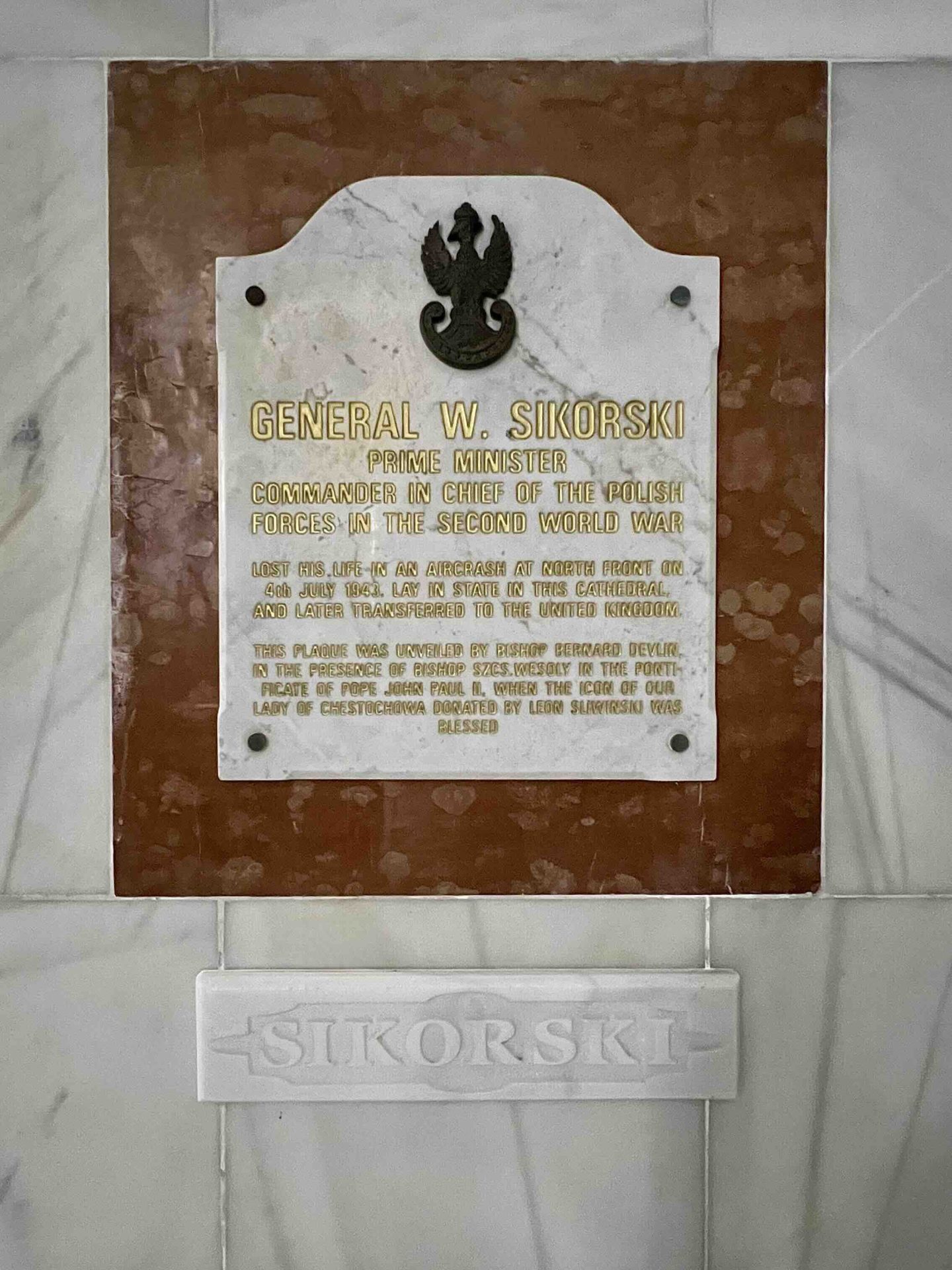
In addition to the primary Sikorski Memorial at Europa Point, other sites across Gibraltar honor his memory. A plaque in the Roman Catholic Cathedral of St. Mary the Crowned on Main Street stands as a reminder of Sikorski’s strong faith and reflects the bond between Poland’s Catholic community and the people of Gibraltar. This plaque holds particular resonance for many Polish visitors, who view it as a symbol of unity and shared values.
The Great Siege Tunnels house plaques honouring General Sikorski and the victims of the 1943 crash. Originally built as a defensive stronghold, the tunnels hold deep historical significance. Inscribed in Polish and English, the plaques serve as solemn reminders of the tragedy, with one marking a vantage point where an eyewitness saw Sikorski’s doomed takeoff.
The Gibraltar-Poland Connection
The Sikorski Memorial, along with other commemorative sites in Gibraltar, transcends the memory of a single individual, symbolizing the strong ties between Poland and Gibraltar that were fortified during World War II. Gibraltar, as a crucial Allied base, hosted numerous Polish soldiers and airmen who fought alongside British forces. During this period, Gibraltar came to symbolise a beacon of hope for the Polish people, who saw in the Rock of Gibraltar a reflection of their own resilience and determination.
Relocating the Sikorski Memorial to Europa Point in 2013 strengthened Gibraltar and Poland’s historical and cultural ties. During the re-dedication, the Polish ambassador highlighted their “unbreakable bond,” reflected in the memorial’s prominent placement. As a landmark and symbol of unity, it honors their shared history and lasting friendship.
A Legacy of Sacrifice and Remembrance
The Sikorski Memorial endures as a symbol of courage and sacrifice, capturing the indomitable spirit of Polish resistance against oppression during World War II. General Sikorski’s leadership and determination inspired countless resistance movements across Europe, offering hope to a nation in its darkest hours. The memorial at Europa Point not only commemorates Sikorski’s life but also serves as a tribute to Gibraltar’s role as an Allied base during the war, a role that significantly influenced the outcome of the conflict.
Gibraltar’s plaques and memorials preserve the events of July 4, 1943, as part of its shared history with Poland. The Sikorski Memorial invites reflection on past sacrifices and the enduring solidarity between both communities, highlighting their struggles as a foundation for a more united future.
The Ongoing Commemoration of Sikorski in Gibraltar
The Sikorski Memorial, along with its associated plaques, embodies resilience, sacrifice, and international solidarity, preserving the memory of General Władysław Sikorski and the shared history of Gibraltar and Poland. These memorials invite contemplation on the human spirit’s strength and the significance of international alliances during times of conflict. In remembering Sikorski and the sacrifices of World War II, the people of Gibraltar and Poland reaffirm a legacy of unity that continues to inspire hope for future generations.
As visitors pay their respects at the memorial, they are reminded of the timeless values of courage and perseverance, underscoring the importance of learning from the past to shape a peaceful and collaborative future.
The memorial is open to the public, and a short bus ride to Europa Point will take you straight there.
Wonderful article Jason, it’s very informative. Reading your articles brings me back to Gibraltar. I look forward to reading more.
Thank you for commenting in Jason’s article and we would like to thank you for coming back to read Jason’s work.